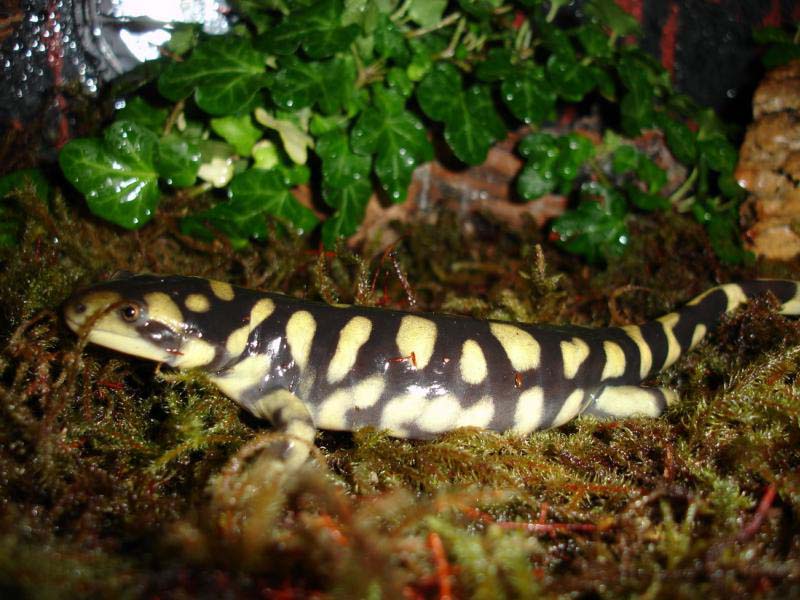
Eastern Tiger Salamander

Ambystoma tigrinum
The Eastern Tiger Salamandar is the largest land-dwelling Salamander is all of North America, and it also has the distinction of being the most widespread. You'll find these guys just about everywhere on the continent except in the coldest northern reaches-- they live throughout the United States, Mexico, and in most of Canada.

You can identify Eastern Tiger Salamanders by their large size and their blotchy green and black markings. As adults they are almost completely terrestrial, and live in burrows that can be as far as two feet underground. They live in a huge range of habitats, including forests, grasslands, and developed areas.

Adults are very loyal to their birthplace, and will return to that spot to breed int eh Spring. Larges numbers will congregate on a single spots, and males will have to isolate the females from the group in order to breed. Males will deposit spermatophores that are picked up by the females to fertilize the eggs. Sometimes other males will actually interrupt this process, deposing the first male on the scene and then placing his own spermatophores. Once the eggs are fertilized, they are laid in masses that number up to 100. The young Salamanders are completely aquatic, but grow very fast-- by the end of summer they have already become adults.

IUCN Status : Least Concern
Location : North America
Size : Length up to 14in (36cm)
Classification : Phylum : Chordata --Class : Amphibia -- Order : Caudata
Family : Ambystomatidae -- Genus : Ambystoma -- Species : A. tigrinum

Comments

  1. I love salamanders, one was living in my front yard a couple of years ago. My family and I came back from a vacation at Mexico and it got in our luggage! x)

    ReplyDelete

Post a Comment

Popular posts from this blog

Burmese Peacock

Polyplectron bicalcaratum Burmese Peacocks are also referred to as Grey Peacock-Pheasants, which is probably a more apt name, as they are not actually Peacocks... though they do belong to the same family. At any rate, they share some physical resemblances to Peacocks- most notably the eyes on their tail feathers. Burmese Peacocks are the national birds of Myanmar, which was called Burma until 1989, though some still refer to it as such. The birds live in several other Southeast Asian countries as well, and are divided into four subspecies. The species as a whole is listed as being of Least Concern , because they have a large range and population size. It unfortunately appears that they may be declining in number, but it is a slow descent that does not yet meet the vulnerability thresholds. The birds are listed under CITES Appendix II, because they can be kept in captivity and grabbing individuals from the wild could become problematic for the species. IUCN Stat...

Bornean Orangutan

The Bornean Orangutan is one of two extant Orangutan species in the world. It is the third largest primate (after Gorillas) and is the largest primarily tree-dwelling animal in the world. Males are substantially larger than females, and average at around 165lbs. Bornean Orangutans are largely solitary. A handful might live within a small range but they will seldom interact with one another. Males and females only meet up to breed, which happens only once every several years. A young Orangutan will stay with it's mother for about five years, and the females tend to go about eight years between births. That is the longest interim period of any animal! Sadly, the Bornean Orangutans are in a lot of trouble. They need large forests in order to thrive, and deforestation and habitat degradation has left many homeless. They are also hunted for meat and for traditional medicines. Conservation areas are being established to help these guys in the wild, and it is believed that there are a...

Four!

For anyone who was counting, yesterday was our birthday-- four years! Four years filled with animals from A to Z, more than 1,100 of them! I can't thank my readers enough, it's been wonderful! And in celebration of that milestone... I'm taking a break. Hopefully not forever, but for a little bit at least. In the mean time I plan on getting a new layout out, along with some updates to some of the older articles. I'll post updates here and on the Facebook page, I'm also brainstorming some new animal-related projects, so keep an eye out! Thanks again for four awesome years!