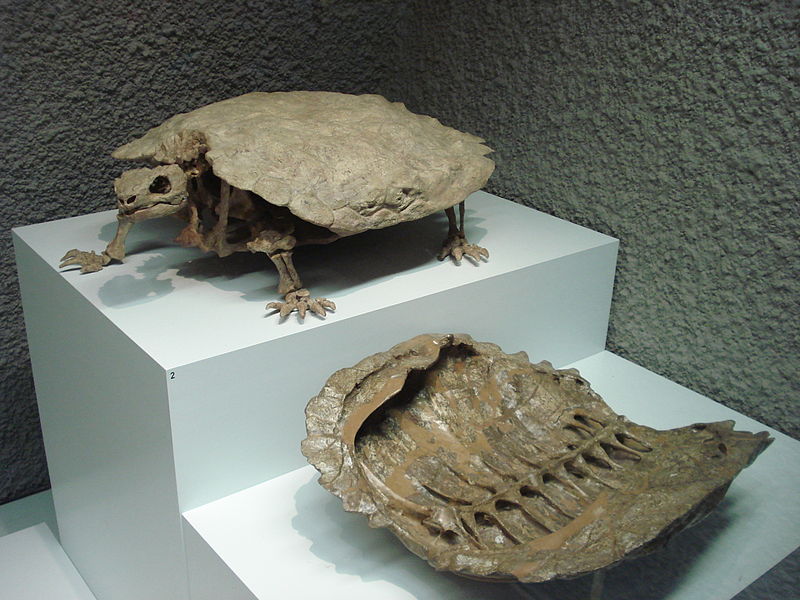
Proganochelys

Proganochelys quenstedti
Poor Proganochelys. For over 100 years it was the oldest turtle species ever discovered. its fossils dated back 210 million years! ...And then Odontochelys was found in 2008 with fossils 10 millions years older... and ruined that "oldest" distinction. Ah well, such is science! I'm sure even Odontochelys will be dethroned at some point; we still have such much to learn about the Earth's past.

Proganochelys fossils have been found in Germany and Thailand, and they show that this was a creature around 1m long. They look remarkably like the turtles that we have today, and even shed some light on how turtle got to be how they are.

Since it already has its shell, Proganochelys doesn't teach us much about shell evolution (Odontochelys helped a bit with that though!). It does, however, demonstrate how turtles lost their teeth very on in their evolutionary development. and it also has the large ear opening that is also found in modern turtles.

One big difference between Proganochelys and modern turtles is the retractability of the head. Our ancient friend simply could not do such a thing. But! They did have small spines on the neck to protect themselves with. Another cool difference? A spiny, clubbed tail!

Status : Extinct, lived around 210 million years ago.
Location : Germany, Thailand
Size : Length up to 3.3ft (1m)
Classification : Phylum : Chordata -- Class : Sauropsida -- Order:  Testudines
Family : Proganochelidae -- Genus : Proganochelys -- Species : P. quenstedti

Comments

Popular posts from this blog

Burmese Peacock

Polyplectron bicalcaratum Burmese Peacocks are also referred to as Grey Peacock-Pheasants, which is probably a more apt name, as they are not actually Peacocks... though they do belong to the same family. At any rate, they share some physical resemblances to Peacocks- most notably the eyes on their tail feathers. Burmese Peacocks are the national birds of Myanmar, which was called Burma until 1989, though some still refer to it as such. The birds live in several other Southeast Asian countries as well, and are divided into four subspecies. The species as a whole is listed as being of Least Concern , because they have a large range and population size. It unfortunately appears that they may be declining in number, but it is a slow descent that does not yet meet the vulnerability thresholds. The birds are listed under CITES Appendix II, because they can be kept in captivity and grabbing individuals from the wild could become problematic for the species. IUCN Stat...

Bornean Orangutan

The Bornean Orangutan is one of two extant Orangutan species in the world. It is the third largest primate (after Gorillas) and is the largest primarily tree-dwelling animal in the world. Males are substantially larger than females, and average at around 165lbs. Bornean Orangutans are largely solitary. A handful might live within a small range but they will seldom interact with one another. Males and females only meet up to breed, which happens only once every several years. A young Orangutan will stay with it's mother for about five years, and the females tend to go about eight years between births. That is the longest interim period of any animal! Sadly, the Bornean Orangutans are in a lot of trouble. They need large forests in order to thrive, and deforestation and habitat degradation has left many homeless. They are also hunted for meat and for traditional medicines. Conservation areas are being established to help these guys in the wild, and it is believed that there are a...

Four!

For anyone who was counting, yesterday was our birthday-- four years! Four years filled with animals from A to Z, more than 1,100 of them! I can't thank my readers enough, it's been wonderful! And in celebration of that milestone... I'm taking a break. Hopefully not forever, but for a little bit at least. In the mean time I plan on getting a new layout out, along with some updates to some of the older articles. I'll post updates here and on the Facebook page, I'm also brainstorming some new animal-related projects, so keep an eye out! Thanks again for four awesome years!