Ah, the Chamois, one of my favorite quadrupeds. How could one not be smitten with their cute little backwards "J" horns?
Chamois (pronounced Sham-Wah!) are antelope-like goats that can be found throughout Europe. In fact, there are more than half a dozen location-based subspecies, all of which live in mountainous areas. They inhabit ranges from the Alps in France, all the way over in the Caucasians and Carpathians. They have also been introduced to New Zealand. It is unsurprising that, due to their mountainous lifestyle, they have developed great speed and agility over the steep terrain.
Female Chamois and their young live in small groups, while the adult males are solitary and only interact with others during the breeding season. Males will fight fiercely for the right to breed, and will drive away the young males from the family groups, occasionally killing them!
Interestingly, Chamois are not hunted for their meat, as many other ungulates are. Rather, their skin is very sought after, and produces a very soft, absorbent, and non-abrasive. This cloth is often spelled as "Chamois," but is pronounced like "Shammy." Chamois are protected in many countries, but hunted is still allowed in restricted numbers.
IUCN Status : Least Concern
Location : Europe
Size : Height up to 30in (75cm), Wieght up to 60lbs (27kg)
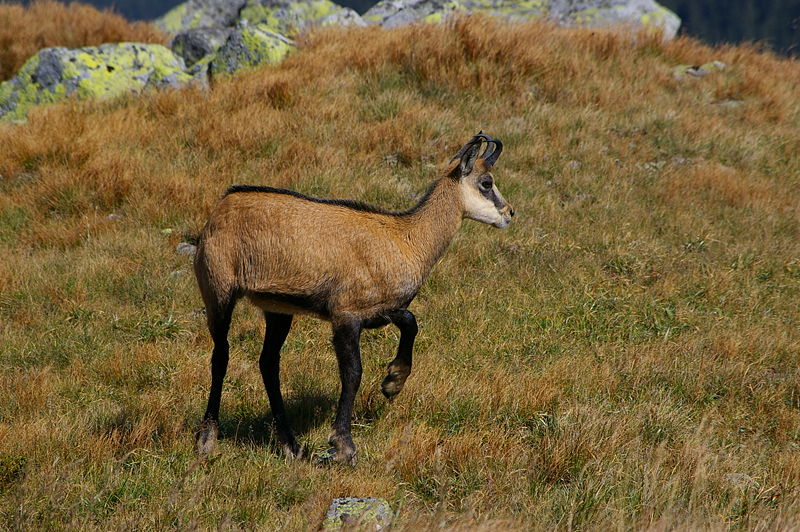 |
| Rupicapra rupicapra |

Female Chamois and their young live in small groups, while the adult males are solitary and only interact with others during the breeding season. Males will fight fiercely for the right to breed, and will drive away the young males from the family groups, occasionally killing them!
Interestingly, Chamois are not hunted for their meat, as many other ungulates are. Rather, their skin is very sought after, and produces a very soft, absorbent, and non-abrasive. This cloth is often spelled as "Chamois," but is pronounced like "Shammy." Chamois are protected in many countries, but hunted is still allowed in restricted numbers.
IUCN Status : Least Concern
Location : Europe
Size : Height up to 30in (75cm), Wieght up to 60lbs (27kg)
Classification : Phylum : Chordata -- Class : Mammalia -- Order : Artiodactyla
Family : Bovidae -- Genus : Rupicapra -- Species : R. rupicapra
Family : Bovidae -- Genus : Rupicapra -- Species : R. rupicapra
Comments
Post a Comment